
See if this sounds familiar…
You walk into work on a Tuesday in May. You got a voicemail about a urinal that won’t stop running at the rec center and a preschool room that can’t seem to stay cool. The recreation supervisor emailed you about some changes to a special event setup due to the weather. Your boss texted you about the public complaining about a fallen branch at one of your busiest parks. And you need to schedule out corrective action based on the last round of playground inspections.
Just another day during the busy growing season, right?
Everything feels like it needs to happen right now (or yesterday). Oh, and one of your crew leaders just called off for the rest of the week.
Prioritizing park maintenance work isn’t just about time management. It’s addressing safety and liability issues, balancing public relations, and juggling available resources as you’re delegating tasks to your team.
Learn why prioritizing tasks is so difficult for parks maintenance teams, tips to help prioritize better, and some common challenges park maintenance managers face.
What Makes Park Maintenance Task Prioritization So Difficult?
Scheduling maintenance and repairs is difficult for any industry, but it can get very tricky for parks and recreation agencies. Here’s what makes this industry unique:
- Asset Diversity: From playgrounds, HVAC units, trails, fitness rooms, aquatics filtration systems, landscaping equipment, and so much more, there is a huge variety of things that need attention from the maintenance team.
- Public-facing pressure: The public is often quick to point out–or post on social media–issues with your parks, facilities, and other amenities.
- Variable staffing: Staffing patterns vary throughout the year, so work capacity also fluctuates. Staff skill levels also vary, so it can be challenging to ensure the most appropriate staff can get to the task when needed.
- No Triage for Incoming Work: Most parks departments don’t have a formal framework for ranking incoming requests. Everything comes in at the same level of urgency, and it is up to the park maintenance manager to discern priority based on the given day.
These are just some of the challenges maintenance managers face as they prep their teams for the day, week, and season. Working through these obstacles involves clearly defining how work is requested, assigned, and prioritized.
Creating a Framework for Prioritizing Maintenance Work
Many methods exist for prioritizing tasks. From color coding to matrixes the prioritization process can be straightforward or seemingly as complicated as completing the task.
Ultimately, you want to set up a framework that is easy to use and for your staff to understand. Here is an example of a four-tiered approach:
Tier 1: Requires Immediate Action
These tasks involve the safety of the public and your staff. Anything that creates a direct risk to an individual should be classified in the first tier. Also, anything that can quickly result in more extensive damage to an asset should be included in the first tier. This can include:
- Broken or jagged playground equipment
- Sewage backup in a public restroom
- Downed branch on a road or heavily used pathway
- A pool's malfunctioning pumps or heaters
Recognize Tier 1 Tasks: If someone can get hurt, the task shouldn’t wait.
Tier 2: High Priority: Complete Within 48 to 72 Hours
Maintenance and tasks that affect the usability of a park or facility, but do not pose an immediate safety hazard. Not doing these tasks may not cause injury, but they can result in significant service disruptions or damage to assets. This can include:
- HVAC issues in commonly used facilities
- Prep work for facility rentals or events
- Restroom repairs before a large event
- Graffiti or Vandalism in a high-use area
Recognize Tier 2 Tasks: If the issue impacts a scheduled program or event or the condition of a park or facility, this task should be moved to the front of the line.
Tier 3: Moderate Priority: Complete within 1 to 2 Weeks
Moderate-priority tasks involve work that has some significance but won’t result in immediate issues if not addressed right away. These tasks can include:
- Small pothole in the parking lot
- Fencing repair that isn’t a safety issue
- Drainage issue near a playground
- Replacing a ripped net at a soccer field
Recognize Tier 3 Tasks: These tasks are important enough to schedule formally, but not urgent enough to displace tasks in the top 2 tiers.
Tier 4: Low Priority/Deferred Maintenance
The final tier involves work that should be acknowledged and documented, but may require capital planning or can be appropriately addressed during slower times of the year. For example:
- Resurfacing a playground
- Doing paint touch-ups in a multipurpose room
- Minor ground erosion near a playground
- Fixing flowerbeds near the park entrance
Recognize Tier 4 Tasks: Record these tasks so they aren't forgotten, but don’t let them compete with more pressing operational needs.
Factors to Determine Priority Levels
Given the variety of assets and ways they may be used for each park and recreation agency, it may be difficult for some to determine priority levels without guidelines. The important thing is to keep things clear, simple, and consistent. A detailed flowchart to prioritize park maintenance tasks may make some decisions easier, but it may also make things needlessly complicated.
Here are some things to consider when prioritizing park maintenance tasks:
- Public visibility and usage level: Is the issue located at a spot that gets a lot of traffic and programming?
- Asset criticality: What will be the impact if the issue causes the asset to fail?
- Usage schedules: When are the next events, programs, or rentals at the asset experiencing an issue?
- Regulatory compliance: Would doing/not doing this task cause issues with government regulations, your agency's insurance, or risk management?
- Resource availability: What is the availability of specialized maintenance technicians or materials to correctly complete the task?
- Weather conditions: Some tasks need to be completed during specific weather conditions. If there is only a narrow weather window to complete a task, it may move up the priority list even if it isn’t as pressing.
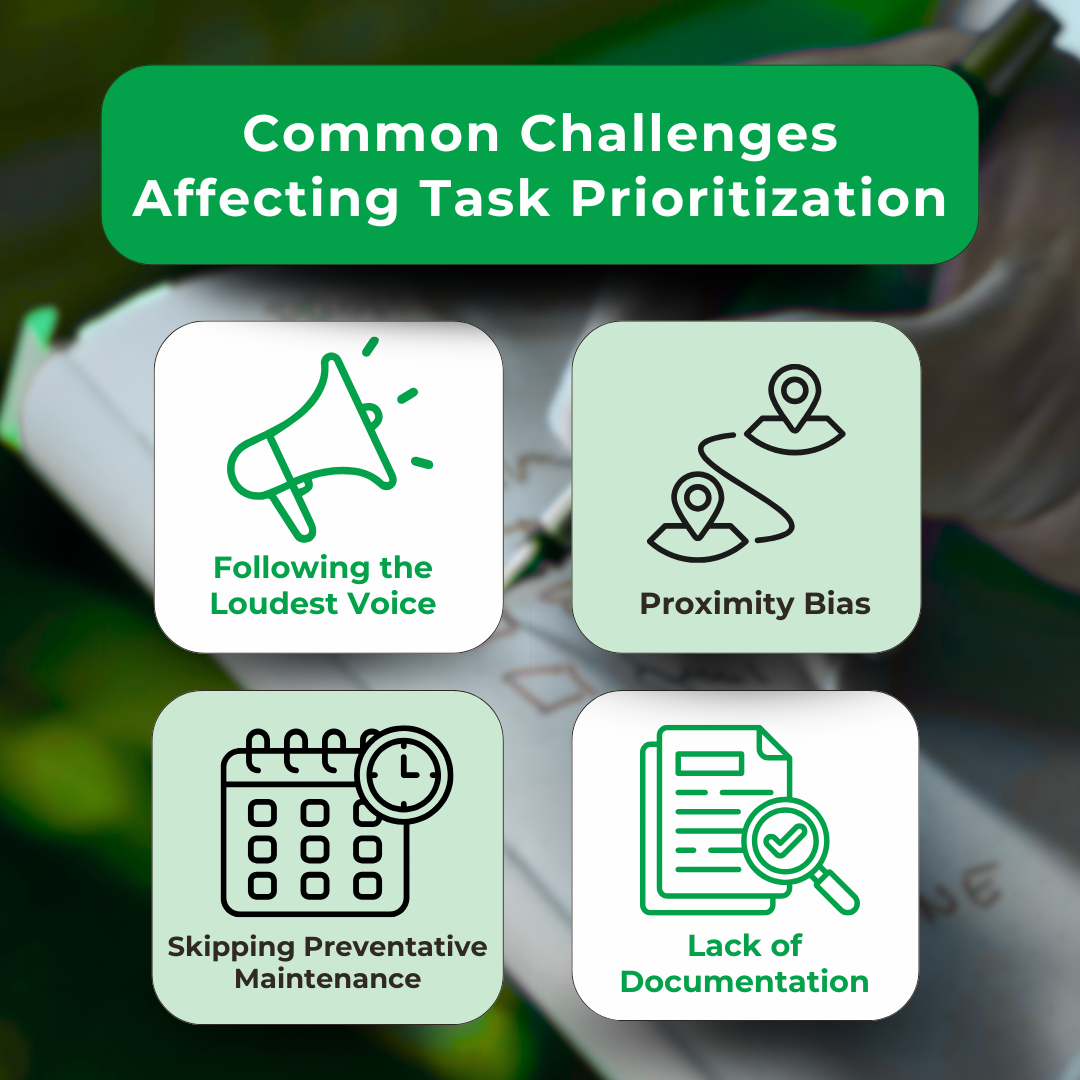
Common Challenges Affecting Task Prioritization
If we were living in a vacuum, when a task comes to your attention, then prioritizing it may not be that difficult. The truth is, however, issues often come up in waves–sometimes at the worst possible time. One fire doesn’t wait until another one gets put out. You may be reeling from learning about a facility repair and get a call about a playground issue that needs immediate attention.
Prioritizing and scheduling tasks is part of the larger juggling act you do every day. As your focus bounces every which way, then you may fall into some common traps many maintenance managers face.
Here are some challenges many park maintenance managers face daily when prioritizing tasks:
- Following the loudest voice. The squeaky wheel gets the grease, right? Well, that may not always be for the best. Those urgent, repeated calls can affect how tasks are scheduled, but more focus should be placed on risk, public visibility, schedule impact, and asset criticality.
- Proximity bias. A crew may notice something nearby and want to quickly take care of it. Even though it may seem like an efficient choice, it may be pushing back the time a higher-priority task gets completed.
- Skipping preventative maintenance. It’s a sad reality–sometimes preventative maintenance needs to take a backseat to reactive maintenance. Preventive maintenance, however, can catch smaller problems before they become a big deal, helping to increase the lifespan of an asset.
- Lack of Documentation. You can’t prioritize what you can’t see. If you don’t have an established work order system or method for recording work completed, there’s a good chance something will slip through the cracks.
Getting Started Priotizing Tasks More Effectively
Here are three steps to get started developing a process of prioritizing tasks.
Step 1: Create a Work Order System
If you are getting calls, emails, post-it notes, and informal hallway meetings about what work needs to be done, something will get missed. Create a standard way where everyone can report what work needs to be done. Require staff to request work consistently, such as via email or computerized maintenance management software.
Having a standard way to create work requests gives a record of what’s needed all in one place. Maintenance managers don’t have to sift through emails, voicemails, and a pile of papers on their desk. Everything is in a predetermined place for review and prioritization.
Step 2: Define Priority Levels
Earlier in the article, we gave an example of different priority levels. You can use this 4-tiered approach or develop your own.
The important thing is to keep things clear, simple, and consistent. A detailed flowchart to prioritize park maintenance tasks may make some decisions easier, but it may also make things needlessly complicated. The last thing your supervisors and maintenance managers need is a convoluted system that wastes time.
Step 3: Get Everyone On Board
Next, get everyone on the same page. Require work requests come through your predetermined system or else they won’t get done. If necessary, hold a training on how to submit a work order.
Ensure everyone on your maintenance team understands the priority levels and how to find them for a task.
Once these steps are established, schedule periodic times to review how the task prioritization is going. Get feedback from both maintenance and non-maintenance staff. See where improvements can be made or where some task types aren’t clearly defined by your established priority levels.
The Takeaway
Effectively prioritizing tasks allows park maintenance teams to be more intentional about the work they need to do. Establishing a system for submitting, scheduling, and prioritizing work requests will save time, headaches, and the risk that something may be overlooked.
Those Tuesdays in May will likely still be chaotic, but at least you know the most pressing tasks are at the top of everyone’s lists.